Oisymi
The oisymi byzantine palace city succeeded the ancient city of oisymi located northeast of the fortress which Homer refers to it as the birthplace of the beautiful Kastianeiras, wife of King Priam of Troy. Their union produced Gargythion who was murdered by the archer Teikros , brother of Ajax in the Iliad.
The advantageous geographical location of Nea Peramos by the coast of Eleftheres bay and on the edge of the fertile valley between the Symbol mountain and the sea was the reason for the early habitation.
Near the end of the 7th century BC the area attracted rogue colonists from Thassos and as a result the city Oisymi was founded on the rocky hill west of the narrow isthmus that connects the peninsula Brasidas
to the mainland.
The acropolis of Oisymi was surrounded with walls made of local granite
and on top rose a temple probably dedicated to the worship of goddess Athena.
The existence of this temple dates back to the Archaic period (8th to 6th century BC) The original temple was destroyed in the early 5th century BC and a newer
one was constructed during the second century BC. The remains of the walls
and the temple are visible today.
The farming based economy of Oisymi also had an area called ‘books’ which contained wineries which today also produce fine wines. Oisymi had trade relations as far as the cyclades and eastern Aegean.
By the 4th century Oisymi was a Thassos colony due to its dependence
to the neighboring island and was thus referred to as one of its continental possesions.
During that 4th century Oisymi also experienced a brief period of autonomy
as witnessed but the cutting of copper coins depicting goddess Athena and they bore the inscription ‘oisymaion’ which is the name of Oisymi citizens.
Then the city was conquered by the king of Macedonia Phillip II and renamed ‘Imathia’ due to the colonization of Oisymi by Macedonians.
Palace city
Palace city evolved during the middle ages and its walls were erected between 1167 and 1170 by the commander of the Byzantine fleet
Grand duke Andronicus Kontostefanos as evidenced by an inscription preserved on the southern wall. Palace city fortress was apparently
a naval base in charge of protecting the northern aegean coast from pirates and invaders.
From an ecclesiastical point of view, palace city was a bishop domain, under the metropolis of Phillipi and the existence of the Diocese of palace city as mentioned from the early 10th century.
Before the mid-14th century palace city fell in the hands of pirate Alexiou from Velikomi Bithynia . Charging from this city pirate Alexis raided as far
as the island of Lemnos . Palace city returned to the Byzantine in 1350 after a three-day siege by John Kantakouzenos.
A few years later namely in 1357 emperor John V ceded palace city , Chrysopolis and Thassos to the brothers Alexis and John. The two of them expanded their rule from the Strymon river all the way to Christoupoli (modern Kavala) thanks
to their military successes against the Serbs. After the death of Alexis , John remained sole owner of the region until late 14th century when it was conquered by the Turks.
Turkish occupation
During the first centuries of the ottoman rule the medieval town was probably inhabited. However according to travelers testimonies the fortress palace city was abandoned by the 18th century.
By the mid 19th century, the area of the port of Eleftheron belonged to Bey Elias
from Drama. In 1869 the area was bought by Russian monks of Mount Athos
and were from the order of St. Andreas in the early 20th century but the aim
was more political than religious in the history of the region serving Slavic expansionism.
Presence of General Brasidas
Ancient oisymi and later byzantine city palace are linked with the name of the great general Brasidas of ancient Sparta who was a participant during the peloponnesian war and was recognized for his strategic contributions.
According to historical sources in april 422 BC, athens and sparta truce ended and next summer the Athenians were preparing to attack amphipolis.
Brasidas anticipated their intentions and executed a surprise raid.
The Athenians suffered a debacle by the Spartans however along with the
seven spartan casualties was Brasidas who was buried at Amphipolis with honors.
The location of Brasidas death is a wooded peninsula adjacent to the ruins
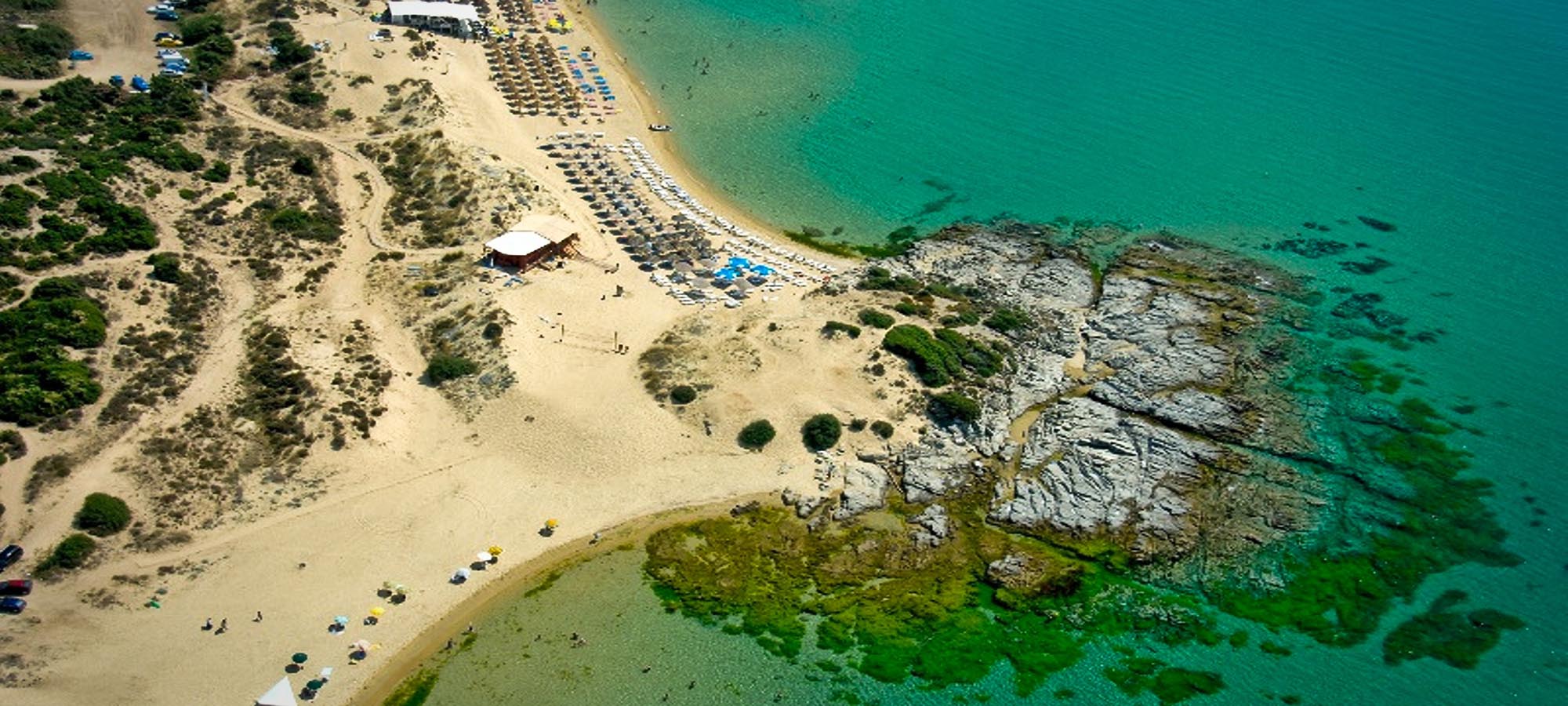
of ancient Oisymi where the modern inhabitants gave the name of the spartan general as ‘Brasidas peninsula’..So they kept alive a piece of history of the peloponnesian war which took place in Nea Peramos.
In 1915 refugees arrived from a port of northeast Thrace overlooking the black sea and settled in a place called today ‘The sixteen’ which were homes built by
the greek state to accommodate them. Because of the swamps and marshes nearby 1/3 of the population died of malaria and it forced them to move to the eastern part of the village.
Later in 1923 came the current inhabitants of the area, refugees from Peramos located on the asian side of the Bosporus peninsula of Cyzicus ..
Residents in memory of their lost homeland named the village Nea (new) peramos. Farming , fishing raising animals are the main activities today.